Bouldering Is an Extreme Sport
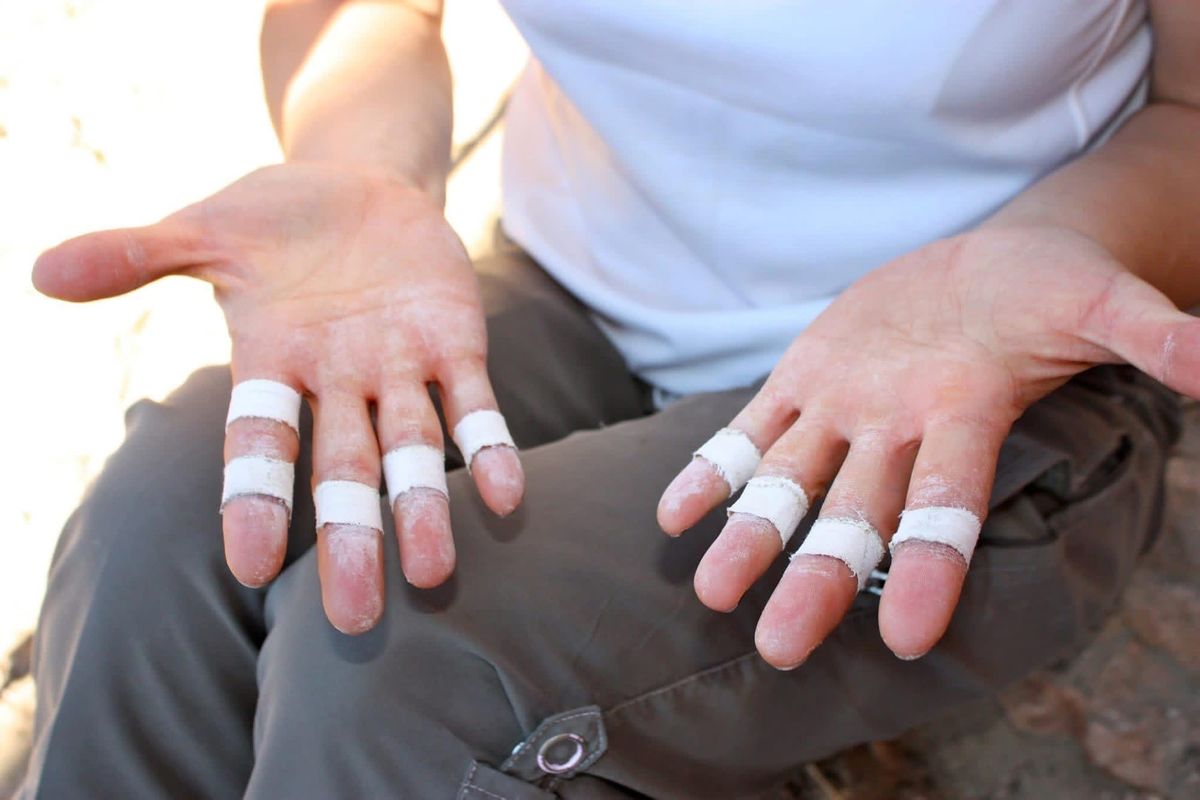
There was a moment recently that unexpectedly reset my perspective on climbing.
I was talking to a friend about injuries, the kind many of us quietly accumulate while bouldering. You know, stiff fingers, clicking shoulders, a pain in the elbow that never go away. A pulley strain right after recovering from something else. One step forward, two steps back.
He simply said:
“Well, bouldering is an extreme sport, isn’t it?”
And honestly, that threw me back a bit. It has become such a normal part of my life and my climbing circle that it's just as natural as breathing, and I never questioned it.
Modern bouldering can feel strangely normalized. You walk into a gym and see people casually throwing themselves at V8s after a full day's work like it’s a normal weekday activity. You see climbers training five days a week, taping their injuries up then continue climbing, projecting through tendonitis, and posting sends online daily. After a while, your brain stops registering how physically demanding and not normal this actually is.
But if you zoom out for a second, bouldering is absurd.
Tiny holds, extreme force production, high tension, repeated impact from landing. Maximal pulling with connective tissue that adapts painfully slowly. And unlike many traditional sports, there’s often no “sub-maximal” mode once you start climbing near your limit. Your fingers, shoulders, tendons, nervous system — they’re all getting loaded near capacity.
That is extreme, even if it's performed indoors over thick mattresses.
And I think this matters because many of us — especially older climbers — quietly carry unrealistic expectations about what progression should look like.
We assume if training is smart enough, disciplined enough, optimized enough, we should simply keep improving linearly. But climbing doesn’t happen in isolation. It is a system of stimulus, recovery, and stress management. While most of us know how to do stimulus (just climb, etc.), and we sort of know about recovery (rest days, etc.), we don't pay enough attention to stress management.
Well, here's the thing. Our bodies are incredibly resilient to stress, and we typically bounce back from them. But if we stack them, it makes it much harder to come back to baseline, impacting recovery and performance. We can think "oh, it's just calming down right?, I'll meditate more", but stress isn't just emotional or psychological.
Have you considered these other stresses?
- Aging.
- Inflammation.
- Metabolic
- Hot/cold.
- Poor sleep.
- Hormonal shifts (perimenopause).
- Work pressure.
- Under-fueling.
- Low-level anxiety or background vigilance from being in an unfamiliar place (gym), meeting new people, etc.
Our body doesn't separate these things neatly into categories. It just experiences load, and if not careful, they keep stacking up throughout the day.
A useful way to think about it is that our body doesn't maintain separate recovery accounts. There isn't a "climbing account," a "work stress account," a "relationship stress account," and a "poor sleep account." There is one organism trying to maintain stability.
When we climb hard, our body has to spend resources on:
- Repairing damaged muscle and connective tissue
- Rebuilding glycogen stores
- Supporting immune function
- Rewiring motor patterns
- Restoring nervous system balance
- Producing hormones and signaling molecules involved in adaptation
Those resources are not infinite.
Now imagine two scenarios.
Scenario A: Climbing stress only
You project a climb on Wednesday.
You sleep 8 hours.
You eat enough protein and calories.
Work is calm.
Life is stable.
Your body can devote most of its resources toward adaptation.
You get stronger.
Scenario B: Same climbing session, different life
You project the same climb.
But:
- You're sleeping 5–6 hours.
- Work is stressful.
- You're worried about finances.
- Your kids are sick.
- You're in perimenopause.
- You haven't eaten enough.
- You're carrying emotional stress.
The climbing stimulus is identical.
But now your body is also managing:
- Elevated stress hormones
- Increased inflammation
- More immune activity
- More nervous system activation
- Reduced anabolic signaling
- Reduced sleep quality
The adaptation machinery has less capacity available. The workout didn't change. The environment in which recovery occurs did.
This is why two climbers can follow the exact same training plan and get completely different results.
One person's body interprets the training as:
"Great. Let's adapt."
The other person's body interprets the training as:
"We're already struggling to maintain equilibrium. Additional adaptation will have to wait."
The nervous system piece is particularly important.
Many climbers think recovery means:
"Did my muscles recover?"
But hard bouldering is often limited by the nervous system more than the muscles.
Hard climbing requires:
- Recruitment of high-threshold motor units
- Fast force production
- Coordination
- Precision
- Risk assessment
- Attention
All of that depends on a nervous system that feels safe and well-resourced.
When we're carrying chronic stress, the nervous system often shifts toward survival priorities. We can still climb and perform. But the recovery signal becomes weaker, making compounding progress hard.
[Thank you, ChatGPT]
So anyhow, my conclusion now is that sustainability in climbing may not primarily be about trying harder, though it is still important. It may be about reducing unnecessary systemic stress so our body can actually adapt to the training we're already doing.
That changes the framing completely. Because then recovery stops being “optional optimization” and starts becoming part of the sport itself.
- Sleep becomes training.
- Nutrition becomes training.
- Emotional regulation becomes training.
- Hormonal health becomes training.
- Rest days become training.
- Respecting your biology becomes training. This means listening to it and give it what it needs, not overriding hunger, fatigue, etc.
I think this is especially important for climbers in their late 30s, 40s, and beyond. Not because we’re weak, but because the cost of imbalance becomes higher. Injuries set us back further than they used to. Recovery debt compounds faster. The margin for error shrinks.
And yet strangely, I don’t actually feel pessimistic about this. In some ways, I feel more optimistic. Because I don’t think the problem is that we’re fundamentally incapable of improving. I think many of us are simply trying to stack high-level climbing stress on top of already overloaded nervous systems from daily life stress.
When we start stabilizing the rest of life — sleep, nutrition, inflammation, emotional chaos, hormonal rhythm, recovery — suddenly the body becomes surprisingly capable and resilient again. And maybe that’s the real long game in climbing. Not pretending we’re still 22, but learning how to build a life that actually supports adaptation. Yes it feels less flashy (I'm staying away from funky coordination dynos), but it's more sustainable. And ultimately, stronger.