Frying My Nervous System
As I started seriously trying to climb harder around early 2024, I’ve created and refined a system: project/rest days, session plans, recovery protocols, all tuned to maximize performance while staying injury-free. And it worked for a while. Within a year, I hit personal bests: sending almost a dozen indoor V8's of different styles/gyms, performing 1-3-5 on the campus board (it's a feat for my 5'2" stature), and half-crimping 155% body-weight on 20mm edge for 7 seconds (Lattice benchmark). I felt like I got this.
But this past month, something strange happened. My body broke down not from tendon strain or joint issues or other obvious injury, but from something invisible and more unnerving: gut issues and insomnia that devolved into panic attacks, a manifestation of a nervous system that was wrecked. I used AI to help me deduce that it was from a combination of emotional, mental, and physical stress, paired with a sensitive nervous system over a fragile hormonal landscape called perimenopause, which is when estrogen and progesterone start to misfire.
When I Went Off the Rails
In July, on my menstrual cycle day 4 (CD4) [By the way, I'll be talking about my cycles a lot. If you're icky about this, time to leave], I felt strong, ready, and restless. I stopped bleeding momentarily, so I did what I had done countless times: a hard session at the gym. I was careful with loading, pacing myself, monitoring my joints, hitting my protein. Nothing reckless or unusual, or so I thought. I felt exhausted but confident, even snagged a V7 on my way out the gym that day.
Then on CD7, I did a mid-high intensity session (about RPE 6-7). Something felt off that day as I lost a lot of power, as if the 2 days of rest and being in the strong estrogen window didn't help. On CD10, after 2 days of rest and a night of bad sleep (warning sign!), I did another climbing session (about RPE 3-4). By all accounts, it should’ve been fine. But inside, something was unraveling.
That night I had my first full-blown insomnia. Then for the next few days, my sleep became very fragmented. I would have a hard time falling and staying asleep. And even if I did, I bolted awake with my heart racing, unable to calm down. My gut puffed up like I’d eaten raw dough. Resting from physical activity for a week didn’t help, and my ongoing left elbow injury, which was starting to recover, remain sore.
What followed was scary as f*ck: my nervous system ran without brakes. It was stuck in fight-or-flight mode and unraveling with no way to rest my body. I incurred 5 back-to-back nights of insomnia followed by panic attacks. I had a severe case of nervous system dysregulation, from a combination of accumulated emotional and mental stress, hard training on a wrong cycle day, and fluctuating hormones. I went to urgent care and was prescribed gabapentin, which helped bring calm back gradually, but the outlook was at least 3 months for complete recovery. That means no more stress and trying hard for a while, and very strict routines to get my body back on track.
Progesterone in Recovery
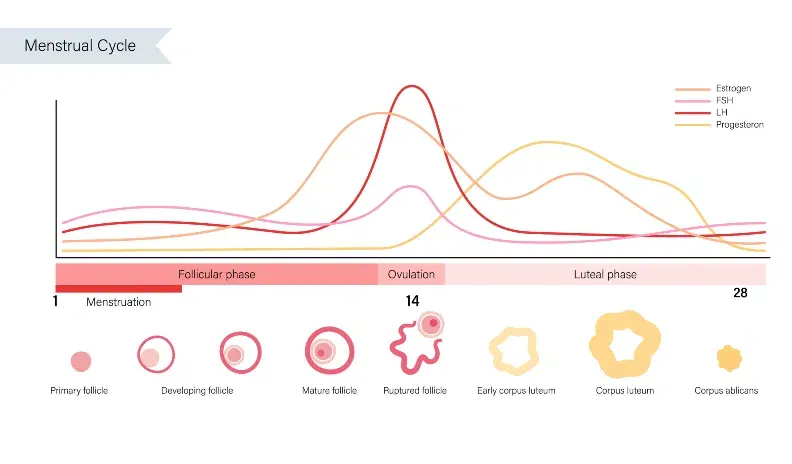
Most training plans run on a 7-day loop. But menstrual biology doesn’t follow calendar weeks. Most women have 28-day cycles, usually ~5 days of bleeding, followed by ~6-8 days of high estrogen (high strength and repair window), followed by ovulation, then a surge of progesterone that drops gradually until the next cycle. This has the effect of cycling physical capacity and mood. [Birth control flattens the hormonal curve, which will be an interesting research project for me later.]
In perimenopause, not only do hormone levels fluctuate and decrease, upsetting physical capacity and mood, ovulation becomes less consistent (especially with stress), and that changes the timing of progesterone. Without a clean ovulation, progesterone gets produced minimally, if at all. And with weak progesterone, GABA becomes weak, the neurotransmitter that calms the nervous system for sleep.
Progesterone isn’t just a fertility hormone. It helps regulate:
- GABA → calm, sleep, parasympathetic tone
- Fascia and tendon health
- Gut motility
- Body temperature and fluid balance
So when I loaded my system with CNS-demanding stress — on CD4 (especially this day), CD7, CD10 — without getting a normal luteal phase relief, I spiraled hard from the stacked stress. My body was unbuffered by the protectiveness of progesterone, and so cortisol spiked and saturated my system without brakes, tipping me into dysregulation. Not only did it give me insomnia, I developed panic attacks over even the smallest things like barking dogs or Netflix.
Failed Ovulation
Even though I've likely experienced this before, but for the first time, I noticed a cycle where ovulation failed: early EWCM, bloating at the wrong time, sleep fragmentation, and a body that felt off. My 30-something hormones normally buffered everything, and I would just recover after resting, not thinking much of it. This time, I lost the hormonal buffer, and I couldn't recover without medical help.
Not everyone's nervous system responds the same way. I happen to have a highly sensitive one (I need numbing gel for regular teeth cleaning), so I crashed instead of plateauing like most people. It's a double-edge sword: I can train less for the same gains, but it doesn't take much to tip me over the edge. For those who plateau instead of crashing, they may suffer from chronic fatigue, brain fog, sleep disturbances, etc, for a long time. So the silver lining for me is that I can detect and fix the problem right away.
I had a capstone V8 on my mind, which would be a test to see how far I've come. But instead, my body offered a different kind of test; one I couldn’t just muscle through. This was the beginning of a new kind of training, rooted in precision and compassion. The capstone V8 will be gone before I fully recover. But this challenge is front and center, and when I learn how to wield my nervous system, I believe I will come out even stronger than before.
What I've Learnt
- Stress tolerance is tied to hormonal balance
When estrogen and progesterone behave unpredictably, so does our stress tolerance. In the past, they would have said I was "hysteric". - CD1–5 is not a good time to train hard
It’s a vulnerable state, with immune, gut, and CNS all running thin. Training hard here is too stressful for the body. - Failed ovulation isn’t rare
Especially in late 30s and 40s. And when it happens, loading hard can push me into a delayed crash. - Insomnia isn’t a mindset issue
For active women, it’s often biological, and a direct result of pushing during the wrong hormonal terrain. - Sleep is paramount
Sleep is when we recover from stress (training or otherwise) and consolidate strength. Never ignore bad sleep.
Cycle-based Training
I no longer train by the calendar week. I train by my cycle’s biology, and I adjust when biology shifts.
- CD1–5 → Deload + Soothing Activities
Walks, light mobility, fuel myself generously. I protect my gut and nervous system here. - CD6–13 → Load Window (If Ovulation Happens)
This is the time for pushing hard, campusing, heavy strength work. If it looks like the cycle is going to be weird (or was weird last time), I scale back. - CD14–17 → Modulation Phase
Estrogen drops, sleep gets shakier. I pivot to skill work, avoiding evening intensity. - CD18–28 → Submax + Tendon Care
I dial down intensity, favor low-RPE training, and tend to soft tissue. Sometimes add sauna.
Yes this reduces my available training time, but I'm at a point now where precision matters more than volume. One short high-quality session yields greater gains than two or three long low-quality ones.
I've started hormone support through Winona HRT (bio-identical combined estrogen/progesterone cream). This is to rebuild my margin so that if I'm not as careful with my loading next time, I won't spiral into another crisis. It does take a few months to see the effects, so I'll write about it later. I'm not suggesting that this is something everyone should try, but I looked at all the pros and cons and decided it's worth it for me.
I had to crash hard to learn how to train in perimenopause with a sensitive nervous system. But now I have a playbook. And if you’re an active person pushing hard in your 40s, maybe this will help you build yours too.